
Introduction
Tech teams should treat code architecture like the foundation work on a house. But most of the time, in a rush to ship features, they skip the foundation to get the walls up faster. Everything starts cracking under load later.
Enter clean architecture—the engineering discipline that separates winners from failures.
The Million Dollar Technical Debt Problem
Picture this: your enterprise platform lands a massive client. They want custom integrations and features yesterday.
Suddenly, your team hits a wall. What should be a two-week feature now needs rewriting half your codebase. This isn't hypothetical—it’s what happens when clean architecture is ignored.
What Clean Architecture Means (Without the Academic Jargon)
At its core, clean architecture means: separate business logic from infrastructure.
- Your core business rules don’t know about databases, APIs, or UIs
- Swap PostgreSQL for MongoDB? No problem.
- Add a mobile app? No rewrite needed.
- Testing? Trivial, because logic is isolated and predictable.
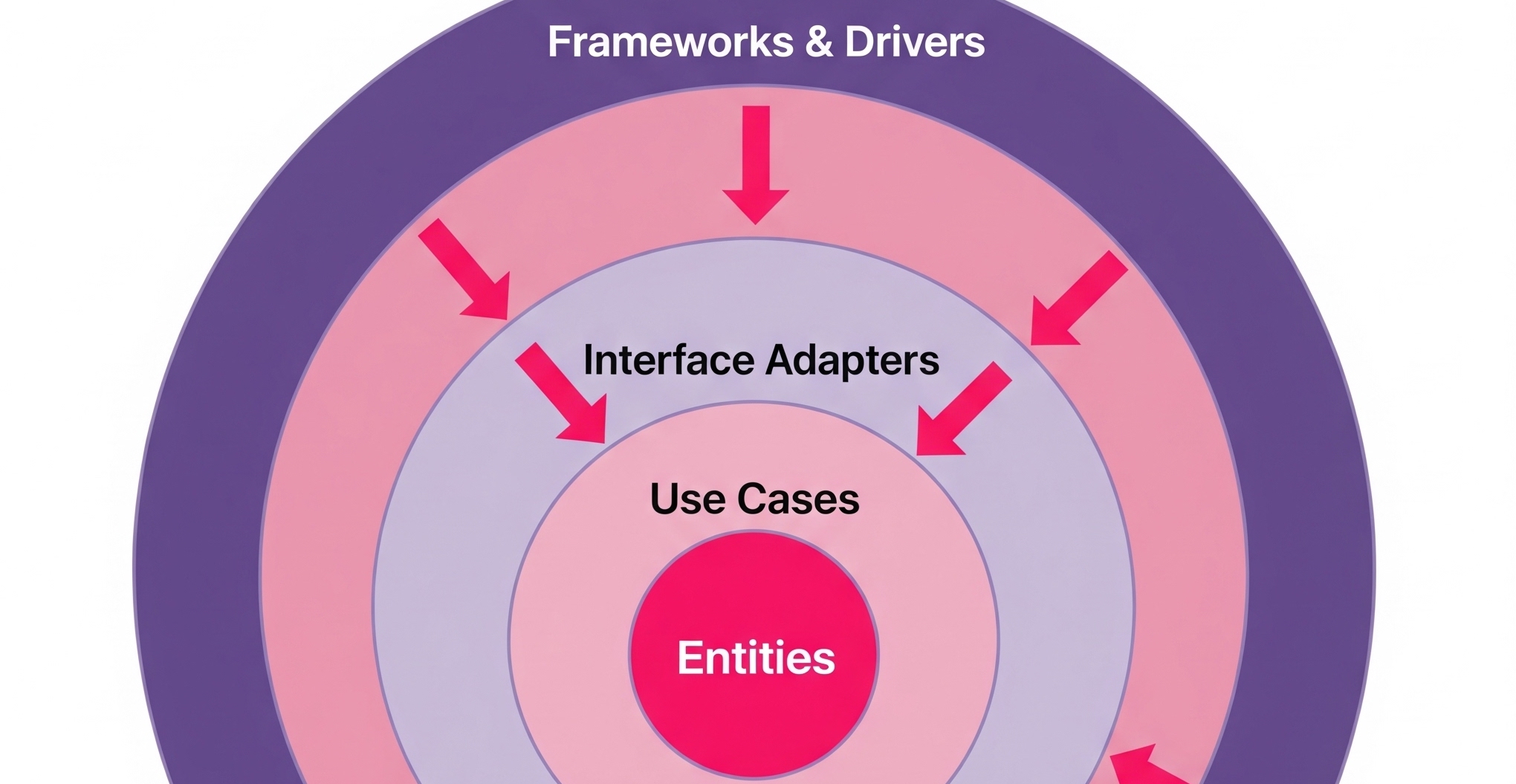
Think of it as software built in concentric layers. The innermost layer is pure business logic. The outermost is infrastructure. Dependencies only flow inward.
Sustainable Delivery
Speed doesn’t come from shortcuts. It comes from sustainable velocity.
Companies like Stripe isolate their core logic—payments, authentication, etc.—from their APIs, dashboards, and SDKs. This allows them to scale, launch, and pivot without starting from scratch.
With clean architecture:
- Developer velocity increases over time
- New engineers onboard faster
- Feature development is predictable
- The product becomes flexible and testable
The Implementation Reality Check
Clean architecture is conceptually simple: separate concerns and depend on abstractions. But it’s hard to maintain in the face of:
- Tight deadlines
- Feature pressure
- “Just this once” exceptions
Start small:
- Use dependency inversion (interfaces instead of direct database calls)
- Isolate core domain logic first
- Use the “Can I test this without a DB?” rule
The Competitive Advantage Hiding in Plain Sight
Most teams are drowning in tech debt. Clean architecture makes you faster, safer, and more scalable.
It’s not about perfect code. It’s about code that improves with time. That’s a strategic advantage—one your competitors likely lack.
The question isn’t “Can we afford clean architecture?”
It’s: Can we afford not to?